



July 2026 Market Review
If you spent part of July on summer vacation, you may have checked your portfolio summary and concluded that not much happened while you were away. The S&P 500 finished essentially flat (-0.06%). Yet beneath that calm surface was one of the most significant, high-velocity rotations of the current market cycle.
Ralph Acampora, a pioneer of technical analysis, famously observed that “rotation is the lifeblood of bull markets” and July provided a textbook masterclass. Capital transitioned out of extended mega-cap tech names and moved directly into cyclical, value-oriented, and real-economy sectors. The Philadelphia Semiconductor Index (SOX), after surging 88% in Q2, pulled back 20.6%. Meanwhile, over 300 S&P 500 stocks finished higher, with nearly 100 advancing by double digits. This internal handoff allowed overheated areas to cool while strengthening broader market breadth.
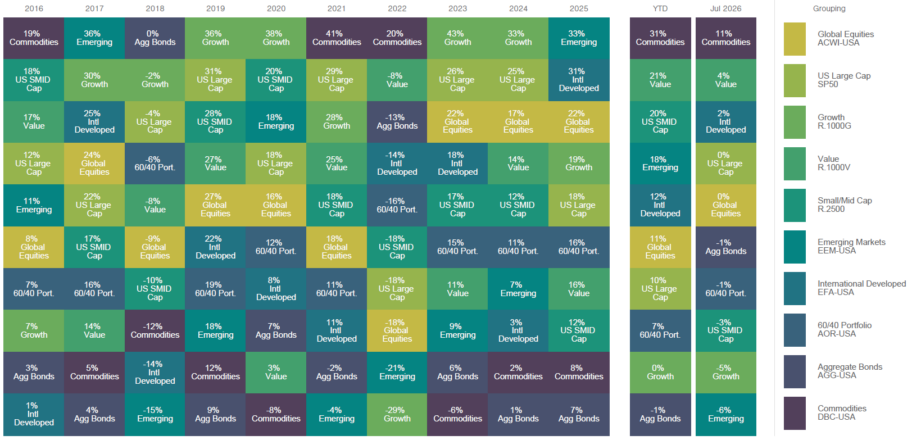
The asset class performance “quilt” included below highlights returns across a range of asset classes over recent years. While leadership shifts meaningfully from year to year, the quilt illustrates how diversified portfolios have historically helped smooth returns over full market cycles.
JULY MARKET HIGHLIGHTS
- Commodities Rebound: Commodities led all asset classes with an 11% gain, driven by early-month energy price spikes and industrial demand.
- Value Asserts Dominance: Large-cap Value (+4%) outperformed Large-cap Growth (-5%) by 9 percentage points, registering one of the top 1-month spreads in decades.
- International Developed Holds Up: Non-U.S. developed markets rose 2%, insulated from technology drawdowns that hit tech-heavy emerging markets.
- SMID Cap Consolidation: US Small/Mid-Cap equities consolidated -3% following their 20% surge in 2Q26, continuing to act as broader market ballast.
- Tech & Growth Reset: Growth assets fell 5% and tech-heavy Emerging Markets declined 6% as momentum trades unwound.
REVENUE ACCELERATION AND HISTORIC EPS SURPRISES
Earlier in the year, observers questioned why equities reached all-time highs in late May despite geopolitical headlines near the Strait of Hormuz, Federal Reserve Chair transition uncertainty, and heavy mega-cap concentration.
In hindsight, the market was doing what it does best: discounting strong fundamentals before they hit the news. As I noted in my introductory January letter, price leads economic data because markets constantly aggregate future expectations. Rather than getting trapped in headline anxiety, the market correctly priced in a historic earnings expansion.
With 88% of S&P 500 companies reporting Q2 2026 results, 86% exceeded EPS estimates, with aggregate earnings coming in 29.2% above expectations, the highest surprise percentage recorded by FactSet since 2008. Across the broader Russell 3000, median earnings growth accelerated from 10% to 14%, the strongest reading since Q3 2021.
This expansion is anchored by accelerating top-line revenue growth, which hit 15.0% year-over-year in Q2 2026:
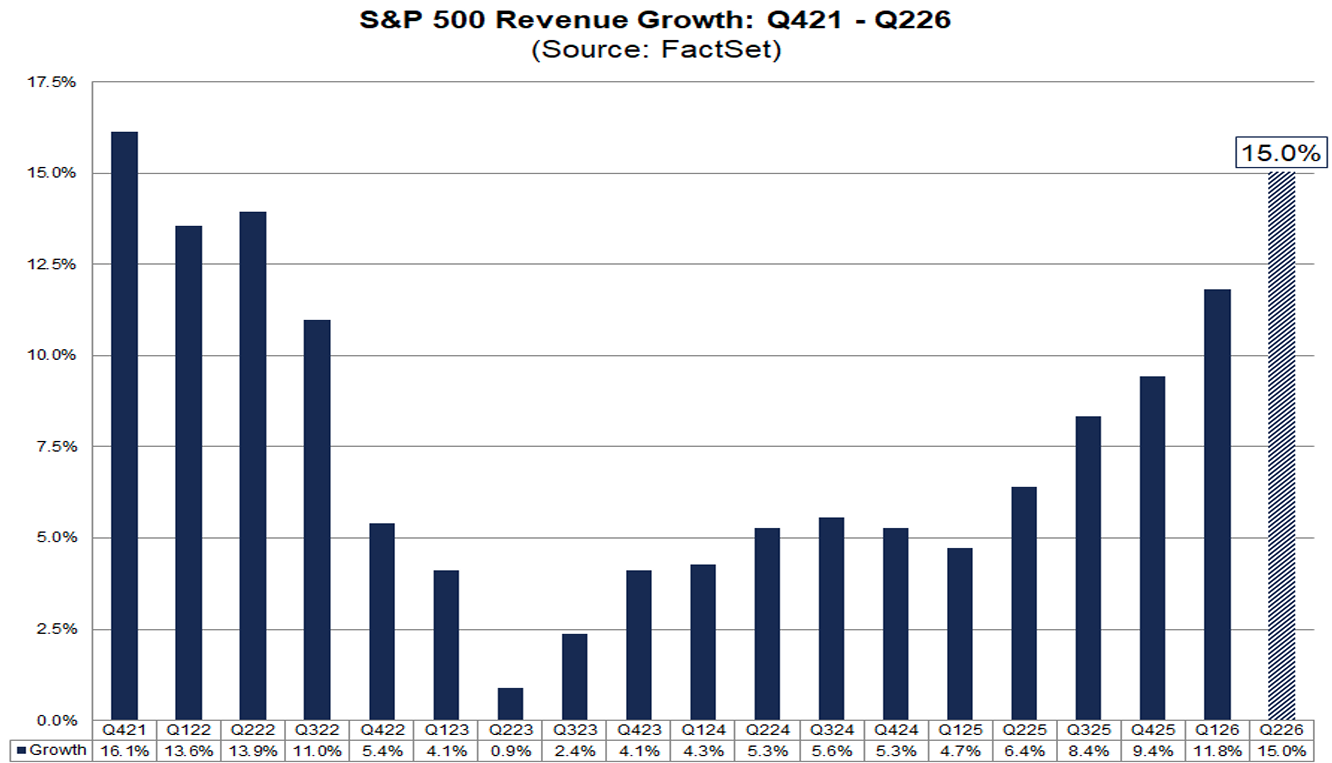
Unlike stimulus-driven spikes as experienced in the post-COVID era, we believe this 15.0% top-line print reflects genuine volume demand, pricing power, and productivity gains from digital infrastructure investments.
NAVIGATING INSTITUTIONAL WINDS AND RATE PRESSURE
On July 29th, the Fed held rates steady at 3.50%–3.75%. Chair Kevin Warsh reiterated a commitment to the 2% inflation target following three months of sticky core PCE inflation (3.4%) and maintained his pivot away from “forward guidance,” forcing markets to price risk without explicit Fed hand-holding.
Fixed income markets reacted as the 30-year Treasury yield reached 5.27%, its highest since 2007. Higher discount rates pressured high-multiple growth stocks, but strong corporate cash flows prevented systemic weakness and accelerated rotation into value.
CLOSING THOUGHTS
Leadership reversals can feel uncomfortable in high-momentum tech names, but structural rotation is how healthy bull markets refresh. We remain positive on the technology sector and the broader AI theme, but July highlights why broad diversification is essential. Ultimately, corporate earnings power are what drive equity returns, and the broader macro evidence continues to support giving this structural expansion the benefit of the doubt.

Les Vasvari, CFA, CMT
Chief Investment Officer
SAX Wealth Advisors
Disclosures
This commentary is provided by SAX Wealth Advisors, LLC, an SEC-registered investment adviser, for informational and educational purposes only. Registration of an investment adviser does not imply any specific level of skill or training and does not constitute an endorsement of the firm by the Securities and Exchange Commission. It does not constitute investment, tax, or legal advice and should not be relied upon as the basis for any investment decision. The views expressed reflect the opinion of SAX Wealth Advisors as of the date of publication and are subject to change without notice.
Index, sectors, and asset class returns referenced are total returns of unmanaged market indices and do not represent the performance of any SAX Wealth Advisors client account, composite, or model portfolio and do not reflect the performance of any actual investment. Indices cannot be invested in directly and do not reflect the deduction of advisory fees, transaction costs, or taxes. There can be no assurance that current investments will be profitable. Actual realized returns will depend on, among other factors, the value of assets and market conditions at the time of disposition, any related transaction costs, and the timing of the purchase. Indexes may not directly correlate or only partially relate to any specific portfolio or may not be represented in a portfolio at all.
Past performance is not indicative of future results. Diversification does not guarantee.
This document contains forward-looking statements relating to the objectives, opportunities, and the future performance of the U.S. market generally. Forward-looking statements may be identified by the use of such words as; “believe,” “expect,” “estimated,” and other similar terms. Examples of forward-looking statements include estimates with respect to financial condition, results of operations, and success or lack of success of any particular investment strategy. All are subject to various factors, including, general and local economic conditions, changing levels of competition within certain industries and markets, changes in interest rates, changes in legislation or regulation, and other economic, competitive, regulatory and technological factors affecting a portfolio’s operations that could cause actual results to differ materially from projected results. Such statements are forward-looking in nature and involve known and unknown risks, and accordingly, actual results may differ materially from those reflected or contemplated in such forward-looking statements. Investors are cautioned not to place undue reliance on any forward-looking statements or examples. None of SAX Wealth Advisors or any of its affiliates or principals nor any other individual or entity assumes any obligation to update any forward-looking statements as a result of new information, subsequent events or any other circumstances. All statements made herein speak only as of the date that they were made.
Certain information has been obtained from third-party sources believed to be reliable; however, SAX Wealth Advisors does not guarantee its accuracy or completeness.