



The Formula General Power of Appointment, Part 2: Building It In from the Start
Last month we looked at how adding a formula GPOA to older irrevocable trusts may allow a basis adjustment without triggering federal estate tax. This week, we’re going to look at how drafting a formula GPOA into a new trust can be beneficial for transitioning wealth to the next generation—especially when there is a large discrepancy in wealth among those inheriting.
The Core Drafting Concept
When a trust is drafted with a formula GPOA, each beneficiary automatically holds a testamentary general power of appointment over the portion of the trust equal to his or her unused applicable exclusion amount at his or her death. The power is capped at the trust’s total value and floored at zero. As was explained last week, inclusion under IRC § 2041 follows from the power’s mere existence, not from any act of exercise. And that inclusion produces the basis adjustment under IRC § 1014.
The beauty of this technique is in its simplicity—the formula does all the work. The amount that adjusts is calibrated automatically to each beneficiary’s tax situation at the moment it matters (i.e. the beneficiary’s death).
How It Plays Out: Marital Planning
The formula GPOA has a natural home in spousal planning—and it connects directly with what we discussed last week. In Part 1, we looked at “fixing” old CSTs to unlock basis step-up. This week, we’re exploring what it looks like to build that in from the beginning.
A CST drafted with a formula GPOA accomplishes exactly that. The CST is designed to use the deceased spouse’s exemption and to stay out of the surviving spouse’s estate—shielding assets from estate tax at the second death. The formula GPOA adds a basis-planning overlay: the surviving spouse holds the testamentary general power over an amount equal to his or her unused applicable exclusion amount at death, capped at the trust’s value and floored at zero.
The result is a trust that works on two tracks simultaneously. If the surviving spouse dies with a large estate that fully utilizes their exemption, the formula produces $0 inclusion. In that scenario, the CST functions exactly as a traditional CST—passing assets to the next generation outside the surviving spouse’s estate. However, if the surviving spouse dies with exemption remaining, the formula sweeps a corresponding amount into the surviving spouse’s estate for a basis adjustment on assets that would otherwise reach the beneficiaries with carryover basis.
Please note, this application is specific to pure credit shelter trusts. A QTIP trust already produces full inclusion under IRC § 2044.
How It Plays Out: Next Generation Planning
For clients with children likely to be at significantly different wealth levels at death, this drafting technique can deliver individualized basis planning without requiring individualized drafting. That’s genuinely valuable for the middle-wealth families where children’s outcomes are most likely to diverge meaningfully and where unused exemption capacity is realistic for at least some of them. The formula GPOA’s elegance is that it handles uncertainty—at the time the trust is drafted, no one knows which child will build wealth, receive an inheritance, or have a modest estate. The formula doesn’t require the grantor to predict that; it self-adjusts at each child’s death to whatever their actual situation turns out to be.
Consider a father who dies with a $9M estate, split equally into three $3M trusts—one for each child—each drafted with a formula GPOA. See below for how this might play out:
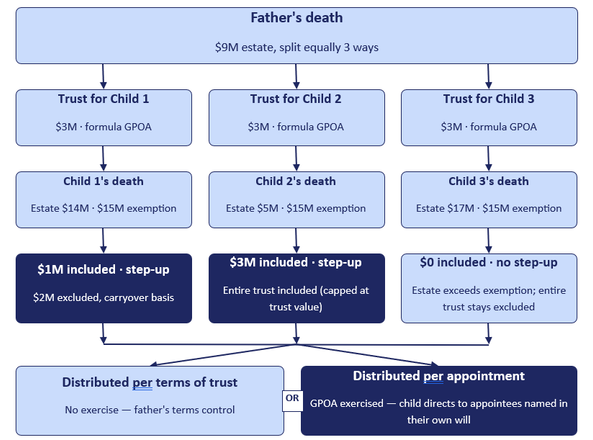
The above illustration assumes a steady $15 million federal exemption at each death and no state estate tax. It further assumes no lifetime taxable gifts, deductions or ported exemption. The illustration is hypothetical, is provided for illustrative purposes only, and is not a projection or a guarantee of any result.
- Child 1’s unused exemption ($1M) is smaller than the $3M trust, so only $1M is swept in for a step-up; the remaining $2M stays excluded with carryover basis.
- Child 2 has far more unused exemption ($10M) than the $3M trust holds, so the power reaches the entire trust–full inclusion and full step-up.
- Child 3’s estate ($17M) already exceeds the exemption, leaving no unused exemption to sweep—the power reaches $0, so the entire trust stays excluded with carryover basis and no step-up.
Same trust language, three different tax results tailored to each child’s exact tax situation at the time of his or her death.
Please note: multi-generational or dynasty trusts are generally not good candidates for this technique as intentional estate tax inclusion runs counter to the perpetual transfer tax shelter those structures are designed to preserve.
What Happens to the Trust Assets
Unless a beneficiary affirmatively exercises the GPOA in his or her will, the trust assets continue exactly where the original trust directs—typically onward to descendants. A beneficiary who does exercise the power can direct the appointed assets to any appointees named in his or her will. This could include individuals outside the grantor’s original distribution plan, unless otherwise limited by the power. The assets that are not subject to the power—i.e. those above the beneficiary’s remaining exemption—continue where the original trust directs regardless of whether or not the power is exercised.
Who Is This For?
Anyone currently working on a new trust—or updating an existing revocable trust—that will fund irrevocable trusts at death is a candidate for this conversation. The techniquemay be best suited to situations where the trust has a finite lifespan—those designed to terminate or distribute at the beneficiary’s death rather than continuing in perpetuity—and beneficiaries who have a reasonable chance of having unused exemption capacity at their death.

Tamara M. Paulun, JD, CTFA
Director of Advanced Planning & Trusts
SAX Wealth Advisors
Important Disclosures
SAX Wealth Advisors, LLC (“SAXWA”) is an SEC registered investment adviser. Registration with the SEC or any state securities authority does not imply a certain level of skill or training. This material has been prepared for general informational and educational purposes only. It is not intended to provide, and should not be solely relied on for, legal, tax, accounting, estate planning, or individualized investment advice, and it does not create an advisory, attorney-client, or accountant-client relationship. The strategies discussed involve complex federal and state tax rules, depend on the terms of the governing instrument and applicable state law, and may not be appropriate for every individual. Information is believed to be accurate as of the date of publication. Before implementing